Israel Purchasing F35 and F15IA Fighter Jets from United States
ALL NEWSWORLDHEADLINES
The geopolitical landscape of the Middle East is characterized by shifting alliances, rapid technological advancements, and persistent security threats. At the heart of this turbulent environment, the State of Israel continually seeks to maintain a qualitative military edge over its regional adversaries. Central to this strategic imperative is the Israeli Air Force (IAF), an institution historically renowned for its operational effectiveness and technological sophistication. To secure its airspace and project power well into the twenty-first century, Israel has executed a meticulously timed defense procurement initiative, investing heavily in two highly complementary combat aircraft from the United States: the Lockheed Martin F-35 Lightning II (specifically the F-35I "Adir" variant) and the Boeing F-15IA "Israel Advanced," a customized derivative of the F-15EX Eagle II.
This multi-billion-dollar acquisition strategy—anchored by comprehensive United States military assistance and unfolding over a strictly managed timeline—represents a profound doctrinal evolution. Designed to counter an array of complex threats, from heavily fortified nuclear facilities to asymmetrical proxy warfare, this dual-procurement pairs the unmatched stealth and sensor fusion of the F-35 with the overwhelming payload capacity and endurance of the F-15IA. This comprehensive analysis explores the chronological milestones, technical specifications, strategic doctrines, and geopolitical implications of Israel’s massive investment in these next-generation fighter jets.
The Historical Context of United States-Israel Aerospace Relations
To understand the significance and the timeline of the contemporary F-35 and F-15IA acquisitions, one must first trace the lineage of United States-Israeli military cooperation. Following the geopolitical realignments of the late 1960s, the United States emerged as Israel's primary supplier of advanced military hardware. This relationship was deepened through decades of strategic memorandums and the institutionalization of Foreign Military Financing (FMF), a program through which the United States provides Israel with billions of dollars annually.
In aviation, this partnership has yielded transformative results. The IAF’s introduction of the F-15 Eagle in the late 1970s fundamentally altered the balance of power in the Middle East. The F-15 achieved legendary status in Israeli service, scoring the aircraft’s first-ever air-to-air kills and playing a pivotal role in the 1981 strike that destroyed Iraq's Osirak nuclear reactor. Later, in the 1990s, Israel acquired the F-15I "Ra'am" (Thunder), a strike derivative tailored specifically for deep-penetration missions.
However, as the twenty-first century progressed, the proliferation of advanced surface-to-air missile (SAM) systems—such as the S-300 and S-400 series—threatened the survivability of fourth-generation non-stealth aircraft. The IAF recognized the urgent need for a fifth-generation fighter capable of bypassing sophisticated air defenses, initiating a timeline of stealth procurement that would eventually dovetail with a massive revitalization of its legacy heavy fighters.
The F-35I "Adir": The Stealth Vanguard Timeline
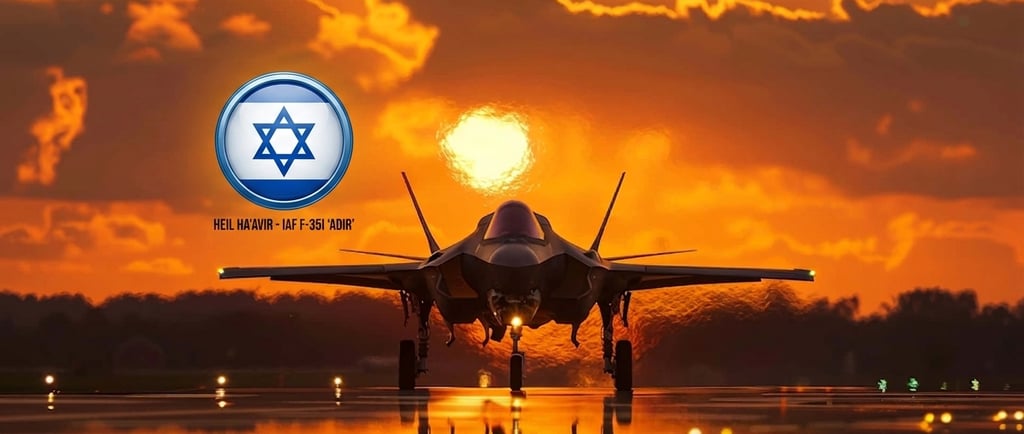
The cornerstone of Israel's modernization effort is the Lockheed Martin F-35 Lightning II. Renamed the "Adir" (Hebrew for "Mighty One"), the Israeli variant of the F-35 stands as a testament to the unique allowances the United States grants to its closest Middle Eastern ally. The procurement of this platform has unfolded over a deliberate, multi-phased timeline.
October 2010 – The Initial Agreement: Israel formally signed a Letter of Agreement, becoming the first international customer to join the F-35 program through the U.S. Foreign Military Sales (FMS) process.
December 2016 – Arrival: The first two F-35I aircraft touched down at Nevatim Airbase in southern Israel, officially beginning the era of fifth-generation stealth for the IAF.
December 2017 – Operational Capability: The IAF officially declared its first F-35I squadron operationally capable, a remarkably fast integration process driven by urgent regional security requirements.
May 2018 – First Combat Use: IAF Commander Major General Amikam Norkin announced that Israel had become the first country in the world to utilize the F-35 operationally in combat, successfully executing strikes across contested Middle Eastern airspace.
2020 – Expansion: A second F-35I squadron officially became operational as deliveries from Lockheed Martin accelerated.
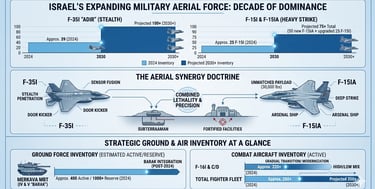
June 4, 2024 – The Third Squadron: Following an initial approval in July 2023, the Israeli Ministry of Defense officially signed a $3 billion agreement with the U.S. government for a third squadron comprising 25 additional F-35Is. Funded by U.S. FMF, this deal stipulated that deliveries would commence in 2028 at a rate of three to five aircraft per year, bringing the committed fleet to 75.
May 3, 2026 – The Fourth Squadron: In the wake of escalating regional conflicts, including intense joint U.S.-Israeli operations earlier in the year, Israel's Ministerial Committee on Procurement granted final approval for a fourth F-35I squadron. This latest milestone pushes the IAF's projected stealth fleet to 100 aircraft, cementing Israel alongside a select few nations with a triple-digit F-35 inventory.
Technologically, the F-35I is heavily localized. Unlike other international operators, Israel secured the right to integrate its own indigenous Command, Control, Communications, Computers, and Intelligence (C4I) systems. This architecture allows the Adir to interface seamlessly with the broader Israeli military network. Furthermore, Israel has developed specialized external wing pods and tailored the weapons bays to accommodate domestically produced munitions, such as Rafael Spice precision-guided bombs.
The F-15IA "Thunder": The Arsenal Ship Procurement
While the F-35 provides unparalleled stealth and survivability, it is inherently limited by physics; maintaining a stealth profile requires carrying weapons internally, heavily restricting payload capacity. Recognizing the need for massive ordnance delivery in prolonged conflicts, Israel turned to the Boeing F-15IA, an advanced derivative of the modern F-15EX. The realization of this capability required navigating complex bureaucratic and political hurdles over several years.
August 13, 2024 – U.S. State Department Approval: A watershed moment occurred when the U.S. Secretary of State approved a potential Foreign Military Sale to Israel of up to 50 new F-15IA aircraft, along with upgrade kits for its existing 25 F-15I "Ra'am" jets. Valued at an estimated $18.82 billion, this package included 120 advanced F110-GE-129 engines, APG-82(V)1 AESA radars, and highly advanced electronic warfare suites.
November 6, 2024 – The Contract Signing: The Israeli Ministry of Defense officially signed the contract with Boeing for the initial batch of 25 F-15IAs. The agreement locked in a delivery schedule slated to begin in 2031, with airframes arriving at a rate of four to six per year.
May 3, 2026 – Fleet Finalization: Concurrently with the approval of the fourth F-35 squadron, the Ministerial Committee on Procurement exercised the option for the second squadron of F-15IAs, ensuring the IAF will eventually field the full 50 newly built arsenal ships authorized back in 2024.
The F-15IA essentially functions as a flying arsenal ship. Lacking stealth, it compensates with extreme range and an extraordinary payload capacity of nearly 30,000 pounds. This allows it to carry outsize weapons—including 22-foot-long deep-penetrating bunker-buster bombs—that simply cannot fit inside an F-35. Moreover, it is equipped with the Eagle Passive Active Warning and Survivability System (EPAWSS), a cutting-edge electronic warfare suite that allows the massive fighter to jam enemy radars, drastically improving its survivability.
The Complementary Doctrine: High-Low and Stealth-Payload Synergy
The simultaneous acquisition of the F-35I and the F-15IA is a meticulously calculated doctrine of synergy. Modern aerial warfare is dictated by the ability of distinct assets to network and complement one another's strengths. The IAF's strategy relies on a strictly choreographed "stealth-payload" sequence.
In a high-intensity conflict—such as a preemptive strike against deeply buried strategic facilities—the F-35I Adirs act as the vanguard. Utilizing their stealth, they penetrate sophisticated enemy air defense umbrellas, identify critical radar installations, surface-to-air missile batteries, and command nodes. The F-35s then neutralize these immediate threats or relay precise targeting data via their advanced sensor fusion back to the network.
Once the F-35s have suppressed the enemy defenses and created a safe corridor, the F-15IAs enter the battlespace. Unburdened by the need to remain invisible to radar, the F-15IAs arrive carrying massive payloads of heavy munitions. Relying on the targeting data provided by the F-35s, the F-15IAs deliver devastating, high-volume strikes against subterranean bunkers and sprawling infrastructure. The stealthy F-35 guarantees access to denied airspace, while the F-15IA guarantees that once access is achieved, overwhelming destructive power can be decisively applied.
The Financial and Political Mechanics
Procuring such an extensive fleet requires monumental financial resources. The financial backbone of this undertaking is the U.S.-Israel Memorandum of Understanding (MOU), which guarantees $3.8 billion annually in military aid. These funds are structured specifically to allow Israel to modernize its forces primarily through American contractors, acting as a strategic subsidy to both the Israeli defense establishment and the American aerospace industry.
To absorb these massive costs—amounting to tens of billions of shekels and spanning multiple decades—Israel implemented the internal "Magen Israel" (Shield of Israel) force-building program. This dedicated budget mechanism ensures the IAF's readiness despite domestic economic fluctuations.
The political maneuvering surrounding these sales is equally complex. The massive approvals in mid-to-late 2024 and the finalized expansions in May 2026 underscore the enduring bipartisan commitment in Washington to maintaining Israel's Qualitative Military Edge (QME). Under U.S. law, any weapons sales to the Middle East must not compromise Israel’s military superiority. By supplying Israel with localized F-35s and customized F-15IAs, the U.S. actively reinforces this legislative requirement while solidifying its geopolitical anchor in the region.
Industrial Participation and Technological Leaps
A critical dimension of these chronological procurements is the profound impact on Israel's domestic technology sector. As a condition of the multibillion-dollar agreements, Israeli defense contractors—such as Elbit Systems, Rafael Advanced Defense Systems, and Israel Aerospace Industries (IAI)—are deeply integrated into the global supply chains for these platforms.
Under an industrial participation agreement signed more than a decade ago, IAI inaugurated a new production line in late 2014 to manufacture over 800 pairs of F-35 wing skins—a contract valued at approximately $2.5 billion spanning 15 years. Furthermore, every F-35 pilot in the world wears an advanced helmet-mounted display system co-developed by Israel's Elbit Systems.
For the F-15IA, the aircraft will feature extensive Israeli-specific modifications in communications, electronic warfare, and munitions integration. This ensures that a significant portion of the allocated funds sustains high-tech engineering jobs locally, fostering a culture of continuous innovation. The integration of these platforms is also actively accelerating broader technological leaps within the IAF, including the development of autonomous flight capabilities and multi-domain artificial intelligence networking.
Strategic Implications for the Middle East
The introduction of expanding F-35I fleets and newly minted F-15IAs fundamentally alters the strategic calculus of the Middle East well into the 2030s and 2040s. The primary target of this deterrence posture is the network of hostile state and non-state actors operating throughout the region, particularly those pursuing nuclear ambitions or aggressive ballistic missile proliferation.
The combined range and capabilities of the F-35 and F-15IA drastically extend Israel’s long-range strike envelope. The distance from Israeli airbases to key adversarial facilities can exceed 1,000 miles, requiring complex aerial refueling and flight profiles. The timeline of these acquisitions—with an expanding fleet of Adirs actively patrolling today, supported by F-15IAs arriving from 2031 onward—sends an unambiguous message: Israel is planning for long-term aerial dominance.
This procurement strategy also heavily influences the broader regional arms race. As Israel solidifies its fifth-generation supremacy and heavy strike capabilities, neighboring states are compelled to reevaluate their military postures, often turning to external global powers for alternative fourth-generation platforms or advanced air defense systems.
Conclusion
The State of Israel's synchronized procurement of F-35I Adir stealth fighters and F-15IA Thunder arsenal ships is a defining maneuver in modern military history. By tracing the timeline—from the initial F-35 commitments in 2010, to its first combat use in 2018, the massive $18.82 billion F-15IA approval in August 2024, and the final authorizations for further squadron expansions in May 2026—the scale and foresight of Israeli defense planning becomes clear.
Leveraging the historically unbreakable alliance with the United States and utilizing Foreign Military Financing, Israel is assembling an air force uniquely tailored to its existential challenges. The stealth and sensor fusion of the F-35 acts as the ultimate enabler, piercing the veil of sophisticated air defenses, while the incoming fleets of F-15IAs will provide the unrelenting firepower required to dismantle deeply entrenched adversaries. As the tectonic plates of Middle Eastern geopolitics continue to shift, the complementary capabilities of the Adir and the Thunder will serve as the vanguard of Israeli sovereignty, deterrence, and survival for decades to come.