A Night of Chaos at the Washington Hilton: The 2026 White House Correspondents’ Dinner Shooting
ALL NEWSWORLDHEADLINES
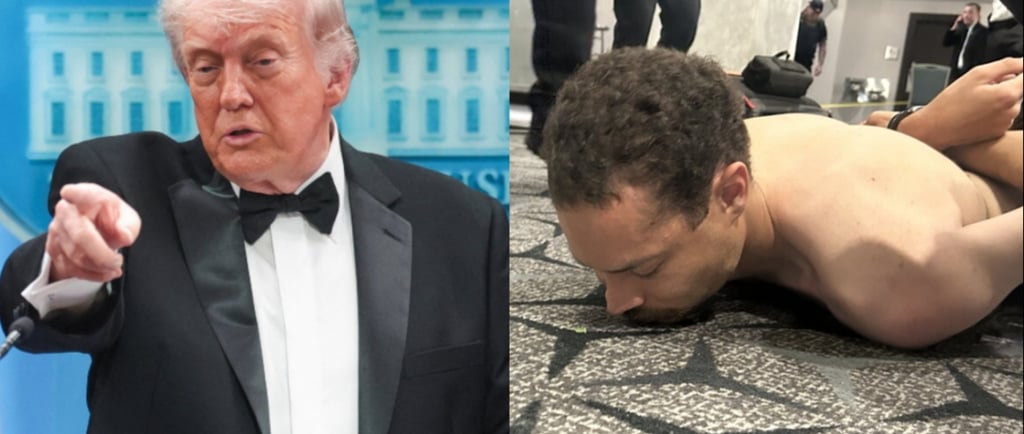
The annual White House Correspondents' Association (WHCA) dinner has long been considered the "prom," of Washington politics—a night where the adversarial lines between the press and the presidency are meant to soften, replaced by satire, jokes, and black-tie camaraderie. However, on the evening of Saturday, April 25, 2026, this tradition was violently upended. What began as a celebration of the First Amendment quickly devolved into a scene of terror, as gunfire erupted near the main security perimeter of the Washington Hilton, forcing an emergency evacuation of President Donald Trump, Vice President JD Vance, and a host of senior administration officials.
As the nation processes the events of that evening, the incident stands as a stark reminder of the fragile security environment in an increasingly polarized United States. Below is a detailed account of the shooting, the suspect, and the immediate aftermath that has left Washington reeling.
The Evening of April 25: A High-Stakes Gathering
The Washington Hilton, a venue with a long and complex history regarding presidential security—most notably as the site of the 1981 assassination attempt on Ronald Reagan—was operating under what experts described as "maximum security." The 2026 dinner was a significant event, marking the first time President Donald Trump attended the dinner during his current term.
The atmosphere inside the ballroom was initially typical for the gala: roughly 2,600 attendees, including the political elite, journalists, and media figures, were settling in for dinner. On stage, mentalist Oz Pearlman was performing for the President, the First Lady, and White House Press Secretary Karoline Leavitt. The air was thick with the usual D.C. energy, but beneath the surface, the security apparatus was intense. Agencies including the Secret Service and the Metropolitan Police Department had implemented strict magnetometer checkpoints, recognizing the inherent risks of having the President, Vice President, and nearly the entire Cabinet in one room.
The Breach and the Gunfire
At approximately 8:36 p.m. EDT, the tranquility of the evening was shattered. According to witnesses and security reports, an individual—later identified as 31-year-old Cole Tomas Allen—approached the main magnetometer screening area outside the ballroom.
Initial reports indicate that Allen, who was a guest at the hotel, moved past the initial security checkpoint before being confronted by Secret Service agents. In the ensuing struggle, Allen, who was armed with a 12-gauge shotgun, a .38 caliber semi-automatic handgun, and multiple knives, opened fire.
Wolf Blitzer, the veteran CNN anchor, reported being only feet away from the gunman when the incident began. He described the sound as a series of distinct, heavy, "serious" gunshots. Pandemonium erupted instantly. Inside the ballroom, the sound of gunfire triggered an immediate reflex; guests who had been enjoying their meals scrambled for safety, ducking under tables and chairs. The Secret Service counter-assault teams, their movements practiced and precise, swarmed the stage.
Videos circulated on social media show the terrifying moment Vice President JD Vance and other senior officials were physically pulled from their seats and escorted out of the ballroom by security detail, while President Trump was surrounded by agents and whisked off the dais within seconds of the shots being fired.
The Suspect: Who Is Cole Tomas Allen?
In the hours following the incident, the focus shifted to the identity and motivations of the shooter. Law enforcement officials identified him as Cole Tomas Allen, a 31-year-old resident of Torrance, California. The profile that emerged painted a picture of a man leading a double life—a quiet, professionally educated individual who held deep, potentially volatile, political grievances.
Profile and Background
Education: Public records and professional profiles indicate that Allen studied mechanical engineering at the California Institute of Technology (Caltech), graduating in 2017. He later obtained a master's degree in computer science from California State University, Dominguez Hills.
Career: Allen’s professional footprint was multi-disciplinary. He worked as a part-time teacher for C2 Education—a tutoring firm—and was locally recognized for his teaching, at one point being named "Teacher of the Month" at a Torrance branch in December 2024. He also identified himself as an independent video game developer, engineer, and scientist on professional networking sites.
Motivations: Investigators are currently poring over a manifesto reportedly sent to family members shortly before the attack. The writings, described by officials, contained anti-Trump sentiment and criticized current administration policies. Allen reportedly referred to himself as the "Friendly Federal Assassin," a moniker that investigators believe highlights the delusion and ideological intensity behind his actions.
Allen had traveled across the country, starting in California and passing through Chicago before reaching Washington, D.C. Law enforcement is currently investigating whether this trip was pre-meditated for the specific purpose of the attack, as he had checked into the Washington Hilton as a guest.
The Investigation and Official Response
The immediate aftermath of the shooting involved a massive law enforcement response. FBI agents, alongside local and federal tactical teams, secured the hotel and began the arduous process of evidence collection.
Charges and Legal Proceedings
Acting Attorney General Todd Blanche has confirmed that the Justice Department is preparing significant federal charges against Allen. While formal indictments are ongoing, officials have indicated that they intend to pursue charges of:
Assault on a federal officer using a dangerous weapon.
Use of a firearm during a crime of violence.
Attempted assassination of the President of the United States.
"This was a targeted act against the foundations of our government," said a senior official close to the investigation. The fact that Allen was intercepted at the checkpoint is being hailed by the Secret Service as a critical success in preventing a potential catastrophe.
Presidential Remarks
President Trump, who was safely evacuated to a secure location within the White House shortly after the shooting, addressed the media in a press briefing late Saturday night. He expressed gratitude for the bravery of the Secret Service agents who tackled the shooter and minimized the event, calling the suspect a "lone wolf whack job." He also used the opportunity to emphasize his long-standing concerns regarding the security of public events and suggested that the incident reinforced his push for a more secure, dedicated event facility at the White House—a project that has faced legal and political hurdles for some time.
Contextual Analysis: A Nation on Edge
The shooting at the Washington Hilton is not an isolated event but rather a flashpoint in a period of heightened national tension. For many political analysts, the incident represents the culmination of a decade of increasing polarization.
The Security Dilemma
Security experts note that the incident raises difficult questions about the balance between public access and protection. The Washington Hilton, while a historic venue, is notoriously difficult to secure compared to purpose-built government facilities. The fact that the shooter was able to get as close as he did to the main screening area has prompted calls for a massive overhaul of how the WHCA and other organizations plan high-profile galas.
"Lone Wolf" Vulnerabilities
The "lone wolf" nature of the attack—where an individual with no direct ties to organized groups but deep ideological commitments carries out an act of violence—is one of the most difficult threats for intelligence agencies to counter. The use of social media and the internet to radicalize or channel individual grievances remains a primary focus of the ongoing FBI investigation into Allen’s online footprint.
The Political Fallout
The incident has predictably triggered a flurry of political reaction. While there is a consensus of condemnation for the violence, the event has already begun to be weaponized by various political factions to argue for their own policy priorities—ranging from stricter gun control laws to expanded mental health funding, and, conversely, to arguments for increased presidential protection authority and more aggressive surveillance of potential threats.
Conclusion: A Turning Point
As of Monday, April 27, the nation remains in a state of shock. The image of journalists and government officials—people who usually occupy separate spheres—huddled together under tables in fear has become a defining visual of the era. The injury sustained by the Secret Service officer, who was struck by a bullet but saved by his protective vest, serves as a grim reminder of how close the country came to a much darker outcome.
For the White House Correspondents' Association, the task ahead is to reschedule the dinner and, more importantly, to determine if the event can ever return to its former status as an open, accessible celebration of democracy. As the investigation into Cole Tomas Allen continues, the nation is left to grapple with the reality that the safety of our highest leaders and the journalists who cover them is never guaranteed, and that the shadows of political violence are growing longer in the halls of power.